Cairn Weather Guide: Reading the Sky on Mount Kami
Weather in Cairn is not ambience — it is a system that reaches directly into grip, piton placement, visibility, and body temperature. Rain turns solid walls into stamina traps, cold makes your anchors harder to place, and darkness hides the holds you were counting on. The climbers who summit are the ones who check the barometer, plan around windows, and treat bivouacs as weather infrastructure. This guide covers every condition and its correct response, verified against the release version (January 29, 2026, PC and PS5). The game publishes no exact percentages for weather effects, so impact levels below are qualitative — drawn from the developers' tips and reviewer/community testing, not invented numbers.
Last updated: July 19, 2026
How Each Condition Changes the Climb
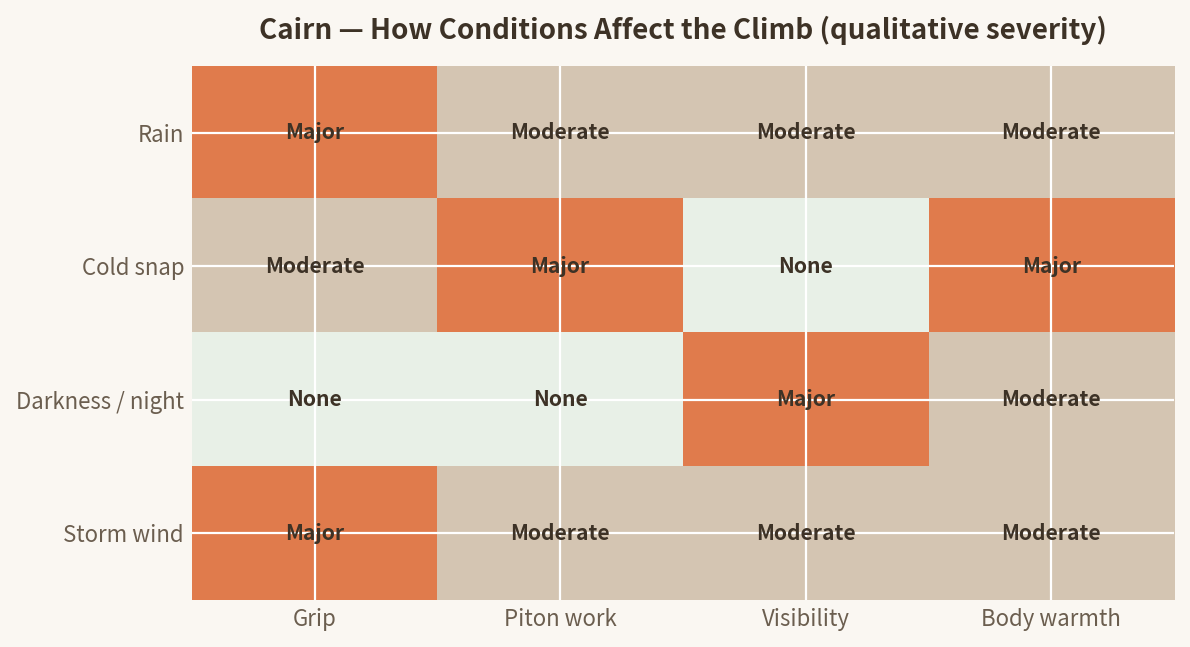
Four conditions matter on Mount Kami. Each one hits a different system, which is why the correct response differs — rain says wait, cold says place anchors early, night says bring light, and wind says shelter.
Condition
Grip
Piton Work
Visibility
Warmth
Verdict
Rain
Major — wet holds slip and drain stamina fast
Moderate — slick rock complicates careful placement
Moderate — rain is sometimes subtle; listen for it
Moderate — wet and exposed accelerates chilling
Wait at bivouac unless the next camp is close
Cold snap
Moderate — stiff fingers, weaker holds
Major — placement is harder when cold
None reported
Major — body temperature is a survival stat
Place anchors early; warm up at every bivouac
Darkness / night
None reported directly
None reported directly
Major — holds are hidden without light
Moderate — upper mountain nights are cold
Climb only with flashlight or glowing gloves
Storm wind
Major — exposure amplifies every mistake
Moderate
Moderate
Moderate
Do not start exposed sections; shelter if caught
Condition-by-system impact matrix, from the table above. Severity is qualitative (community and reviewer testing) — Cairn publishes no exact percentages for weather effects.
Your Weather Toolkit
Tool
Role
Field Tip
Barometer (D-pad Left / key 2)
Forecasts incoming weather before visual cues
Check it at every bivouac and before any long push
Flashlight (D-pad Up / L2)
Reveals holds in darkness and shadowed rock
Free to carry — turn it on early, not after you are lost
Glowing gloves (upgrade)
Visibility in darkness and bad weather
Found in troglodyte structures; worth the detour
Bivouac kit
Warm up, cook, sleep, save — the weather shelter
Sleeping through bad weather is free; falling in it is not
Cooked food & hot drinks
Manage body temperature and stamina together
Cook before sections you know are cold and exposed
The weather decision loop: every bivouac is a forecast check, and every forecast maps to one of three actions — climb, wait, or shelter mid-pitch on a piton.
Five Weather Rules for the Upper Mountain
01
Barometer before boots
Check the forecast at every bivouac. A clear window is a resource — spend it on the hardest wall ahead, not on filler terrain you could climb in worse conditions.
02
Rain means stop
Wet rock attacks your grip, which attacks your stamina, which is how falls happen. If rain catches you mid-pitch, clip into a piton and wait. Off-belay is a full stamina restore anyway — you lose nothing by waiting.
03
Anchors before warmth runs out
Cold makes piton placement harder. In cold conditions, place protection early in each section while your hands still work, not when you desperately need it.
04
Light before dark
Turn on the flashlight before holds disappear, and keep the glowing-gloves upgrade in mind when exploring troglodyte structures. Night climbing without light is self-inflicted difficulty.
05
Bivouacs are weather infrastructure
Sites are finite and some sit off the main path. Treat every bivouac as a shelter you might need later — knowing where the next one is matters as much as knowing the next hold.
FAQ
How do I check the weather in Cairn?
Use the barometer in your quick items — D-pad Left on controller, key 2 on PC (the same slot as your bottle). Checking it before leaving a bivouac tells you what is coming, so you can decide whether to push the next wall or wait. Weather in Cairn is a gameplay system, not decoration: rain, cold, and wind each change how the climb behaves.
How does rain affect climbing in Cairn?
Rain seriously degrades Aava's grip — reviewers note it matters so much that you should listen for rain, not just look for it. Wet holds turn routine sections into stamina traps. If rain starts mid-pitch, get to a piton or ledge and wait it out; if the barometer warns of rain before you start, stay at the bivouac.
What does cold weather do in Cairn?
Cold makes piton placement harder, so you should secure your anchors before your warmth runs out. Body temperature is also one of Aava's survival stats alongside hunger and thirst — bivouacs let her warm up, and cooked food and hot drinks help manage it. Long exposed pushes in a cold snap are how runs end.
Is it safe to climb at night?
Possible but expensive. Darkness hides holds, so you need the flashlight (D-pad Up / L2 quick items) or the glowing gloves upgrade from troglodyte structures to see what you are grabbing. Night also pairs with cold on the upper mountain. Unless a wall is short and well-protected, sleeping through the night at a bivouac is almost always the better call.
When should I wait out weather instead of climbing?
Wait whenever the barometer shows incoming rain or storm and the next section is long, exposed, or low on natural rest spots — conditions multiply the cost of every mistake. Climb through weather only when the next bivouac is close and your protection is already placed. The mountain's rule is simple: bad weather should change your plan, not just your mood.
Last updated: July 19, 2026. Weather mechanics verified against the release version of Cairn (PC/PS5, January 29, 2026). Impact levels are qualitative — the game publishes no exact weather percentages. Fan guide — not affiliated with The Game Bakers.